Mad Mien

December 17, 2009 - Leave a Response

Tell us how you really feel David Colman! In a story for the New York Times style section today (with delightful photo-illustrations, by the way, shot by Douglas Friedman), he celebrates the ’50s- and ’60s-style of young men these days – seen mostly in New York, natch – and lowers the sartorial boom on their elders:  “Young men are embracing the “Mad Men” elements of style in a way that the older men never did, still don’t and just won’t. The result is a kind of rift emerging between the generation of men in their 20s and 30s and those in their late 40s and 50s for whom a suit was not merely square but cubed, and caring about how one looked was effeminate.”

Whoa there, boy. Colman makes some convincing points about young men becoming entranced with the sartorial bounce of Rat Pack style as well as the dreary conformity of casual wear that has been adopted wholesale by our society because “it’s comfortable.” But his undisguised scorn for anyone older than (horrors!) 45, who Colman says, is always “the worst-dressed man in the room, wearing a saggy T-shirt and jeans,” permeates the whole story to the point of absurdity.

Equally absurd are some of his conclusions, starting with the one above that boomers find caring about fashion “effeminate” – his word, not mine. I don’t know where he’s been the last 20 years or so, but men of that generation have been as exacting about their style as they have been about their wine, their coffee and their cuisine – and somehow remaining secure in their masculinity at the same time.  And yes, young men may have rediscovered the suit, but the “olds” somehow spent millions of dollars on suits from Armani, Prada, Gucci, Ralph and Dolce & Gabbana since they came of age in the ’80s.

Colman also cites blogs like A Continuous Lean and The Trad to bolster his case but that works both ways – even a casual reader of the grandaddy of style blogs, The Sartorialist, will come away with a renewed appreciation for the often-dashing style of men in their middle years – and beyond.  Next to images like the one below, some kid rocking a ’60s sack suit in the name of “irony” looks like a rank amateur.

Colman does have one good point – yes, there are lots of men who couldn’t care less about what they put on in the morning, but unfortunately that malaise cuts across all ages. Here’s hoping his precious vanguard of hipster suit-wearers has some effect on the rest of their own generation outside of Brooklyn and Manhattan. But I’m not holding my breath.

Glove Me Do!

December 16, 2009 - Leave a Response

I guess if Madonna’s doing it, then it’s a trend. Long black gloves seem to be the accessory of the moment on the red carpet, as both Madge and Goldie Hawn were seen sporting them at the New York premiere of Nine the other night, possibly just to ward off the winter cold in style. But then, I first noticed them out here in usually mild L.A. on Mad Men’s Christina Hendricks at the Divine Design benefit a couple of weeks ago, and paired with her nude bombshell dress, it was clearly about drama.

Saucy, as the Brits would say. Maybe just the thing to sport at a holiday party. Ladies, the gloves are on!


Some Liked It Hot

December 14, 2009 - Leave a Response

There’s a funny article in The New Yorker this week about what the audiences – mostly women – have been wearing to see the off-Broadway play Love, Loss, and What I Wore, by Nora and Delia Ephron, adapted from the memoir by Ilene Beckerman. Though the audience members mostly favor “sober chic” ensembles of cashmere  sweaters and dark wool pants, some of them take a walk down fashion-memory lane. My favorite, Jill Leider (identified as a classmate of Nora Ephron’s at Beverly Hills High), laments over the way people dress these days, including her own wool pants in the bargain: ” ‘From Banana Republic,’ she said with disdain. ‘I should have today the clothes I had then.’ “

From what she told the writer Rebecca Mead, her closet must have been something: “The hot pants! I remember going to La Grenouille in our shorts and boots. At one point I had thirty Courrèges,and as many Puccis. We all did. I wouldn’t have gone to the supermarket then in what I wear to a restaurant now.”

The hot pants! That made me really laugh out loud. For those too young, or pretending to be too young, to remember, these couture shorts were all the rage circa 1971. Not only for the young, but as Ms. Leider accurately remembers, for society ladies who definitely lunched in them as well as danced the night away in evening versions (often with some kind of front-slit overskirt). It was a brief (no pun intended, really) but worldwide phenomenon, from New York (a Kennedy sister or two), to London (Twiggy, duh) to Paris (the sublime Jane Birkin, seen above).

I was a kid in school then and remember a girl in my class – the daughter of the local junior fashion shop owner – who wore a different hot pants get-up every day for the entire spring term – in Omaha! Of course, Americans were quick to see the commercial possibilities of the leggy trend and several airlines in those “Fly Me!” days adopted them as stewardess uniforms, including Southwest. Ready for takeoff!


The Magic Christian

December 3, 2009 - Leave a Response

So I’m sitting here this morning with a bit of delicious melancholy from Glee last night, which closed with a heartrending version of Smile (“though your heart is breaking…”) that seems to go hand in hand with the news that, for all intents and purposes, the House Of Christian Lacroix is over. Promised salvation to the bankrupt designer in the form of Ajman sheikh failed to materialize and so French Courts approved a plan to allow the owners, the Florida-based Falic Group of duty-free renown, to covert Lacroix to a licensing operation with only a skeletal 11 employees.

Lacroix made a heroic last stand at his ultimately final couture show in July with a somber but elegantly minimal (for him) collection pieced together with donated (mostly black) fabrics and the labor of volunteer workers – and provoked a lot of “why didn’t he do this before?” comments afterwards from fashion critics but I don’t think his heart was really in it. Lacroix was always a provocateur as well as a technician, starting with his audaciously outsize “pouf” dresses of the ’80s that made his name, and through the intervening years with an improbable arsenal of his own – a jumble of lush roses, polka-dots, improbable colors and mad prints. Somehow the forced juxtaposition of black and midnight blue couldn’t hold a candle to that.

No, it’s the previous couture for Spring 2009 (seen in the larger pictures), that confirms that Lacroix’s design derring-do was just as astonishing, even after roughly 25 years. It’s not that he couldn’t do minimal, in his way – I treasure a letter I received from Mr. Lacroix complimenting me after I styled an actress in one of his gowns, a black strapless, gilded with a jeweled brooch and oversize acid-green velvet bow. That was his idea of minimalism. Now, the postmortems have already started, suggesting an unwillingness to change with the times, an unhealthy reliance on couture profits, the lack of a blockbuster fragrance. All valid points, I’m sure, but I think Lacroix also suffered from  lack of a “story” in this hyper-media age – he didn’t run around with movie stars like Armani, he didn’t maintain a string of fancy homes like Valentino and he didn’t make himself over each season to play a runway role like Galliano. Without an illuminating narrative, it’s pretty hard to see those magical Lacroix colors in the dark.

GaGaggle!

December 2, 2009 - Leave a Response

Lady GaGa is on the January cover of Elle and I’m only half-surprised. She’s toned down her trademark bizarre appearance in her latest TV appearances on Jay Leno and the AMAs and starting to work the sexpot vibe, albeit the 2009 version of sexpot – big blonde bouncy curls, no pants just panties, tattered Balmain-style leather.

I saw the GaGa shots on Jezebel, which continues to fascinate me. They do have a lot of fashion content amid the post-feminist postings, like the thoughtful stories – yesterday’s about Lacroix - from Jenna, formerly Tatiana, the Anonymous Model (long story but basically she quit the runway and dropped her decoy byline). Also frequent red-carpet roundups. And, of course, their famed preoccupation with the airbrushing sins, inflated egos and mundane content (their view, not necessarily mine) of the “ladymags”, the fashion MSM – Bazaar, Elle, and especially Vogue.

So wading into the comments section of their post about the GaGa both bemused me with its youthful (at least I hope it was youthful) enthusiasms and frightened me a little about the future of women as fashion consumers. First there is dismissal of GaGa’s sexy turn, “…she looks like every other sexy-faced-fake-eyelashed-skinny-corset-wearing pop star out there.” Some back and forth follows – is she bi, what does it mean, does it matter?

Then, like the shark approaching in Jaws, comes the comment about the cover image itself: “I hate to be the one to point out an airbrush FAIL…but doesn’t her right arm look freakishly small at the armpit/ shoulder joint area?” Twelve posts follow about whether it really is the dastardly retouching or just foreshortening because of the photographer’s angle. Nothing’s really settled, but moving on, one commenter exclaims, “I hate ladymags, but I am buying the fuck out of this!

The convo then skips through a few posters comparing notes because their dads like GaGa, her makeup, her poses, and then a discussion of what to wear to a GaGa concert: “The lack of pants is key. We are all wearing redonkulous dresses from Forever 21 with crazy colored leggings.

Lastly comes the question of her artistic cred, including the touchingly honest, “You win, Lady Gaga. My head hurts whenever you do anything, but I’m okay with that.” Then the possibly naive, “Yes, she puts a lot of it out there for the world to see, but it’s obviously done by her because that is a part of who she is, not because she thinks it will sell records.”

And then, finally, a larger cultural context, “She also does a great job of referencing the fetish community and probably challenging vanilla and middle america more than they quite realize. Rock on Gaga…” What could I possibly I add? Rock on, indeed.

Stay, Little Valentine, Stay

December 1, 2009 - Leave a Response

Today is World AIDS Day and, to quote the character of Addison De Witt from  All About Eve, I don’t want to be “maudlin and full of self-pity.” On the other hand, when I saw the image of the White House today with its giant commemorative red ribbon, it got me thinking how very far we’ve come from those dark days of the early 80s when the Reagan White House wouldn’t even acknowledge the disease. It’s symbolism, I know, but it’s beautiful symbolism – especially when you consider the intentions of the Visual AIDS Artists Caucus, the New York-based creators of the Red Ribbon Project in 1991. They stipulated that the anonymously credited red ribbon be made freely available, without copyright, to raise awareness and mark the devastation of the epidemic, but also, according to Wikipedia, settled on the scarlet moniker  because of its “connection to blood and the idea of passion — not only anger, but love, like a valentine.” So with some sadness that will never go away, but also with a smile, I’m sending a valentine of my own today to all my friends in the fashion industry – lost so long ago - to Timothy, Jim, Claude, Robert, Roger, Brian, the two Doug’s, Terry, Bill, Kip, John from Lincoln, my assistant David, John from NYC, Daniel, Dennis, Jay, another Jay and his roommate JR, Yvon, Jeffrey and Timothy the models, Richard, Barry, Herb, David ….

“Sky”               Ross Bleckner 1999

Standard Gold

November 30, 2009 - Leave a Response

I was a little surprised to see that Vogue chose to dress the always-stunning Cate Blanchett in a gold column gown for their December cover – the dress is almost a dead ringer for the gown she wore on the cover of Vanity Fair earlier this year. Don’t get me wrong, the lady would look glamorous in a gunny sack but, for red-carpet outings, she often picks choices from the further realms of fashion: McQueen, Gaultier and showstoppers from the Armani Privé runway. So Vogue had the perfect opportunity to put a fashion iconoclast in something a bit more memorable. But instead it was same gold, same old.

Accessing Audrey

November 25, 2009 - Leave a Response

I’ve been on a ’60s kick lately (even though I’ve been absent from the blog for a bit) and now comes the news of an auction of clothes largely from that decade from the wardrobe of the incomparable Audrey Hepburn. The big numbers are from Givenchy, her lifelong designer and friend, like the silk cloqué dress above from his autumn-winter 1966 collection that’s a most distinctive shade of blue. Seriously, the woman could even make a pastel look sophisticated. And as the catalogue notes, she ordered the dress (no loaners for Miss Hepburn!) for her publicity tour for Two For The Road, one of my all-time favorite movies.

Of course the auction includes loads of little black dresses, her trademark, and the story behind it is pretty rich. In 1951, Audrey, then 21, met Tanja Starr-Busmann, the 15-year-old daughter of a Dutch diplomat, in London where their families were neighbors. It was the start of a life-long friendship, and periodically Audrey would load up a big box with her haute couture cast-offs and send them off to Tanja. It really was a different world – Busmann even gave one of the Givenchy gowns to the nanny! Now all these years later, Kerry Taylor Auctions in London has acquired “the collection” and it’s set to go under the hammer on December 8, with half of the proceeds going to Unicef and the Audrey Hepburn Children’s Fund. Experts expect the sale to net north of $150,000, but authenticated Audrey pieces rarely come on the market and, after last week’s Yves St. Laurent sale where his old pots and pans went for $22,000, I think it’s anybody’s guess. I mean it’s Audrey Hepburn!

And then there is her wedding dress – for the marriage that never was. While she was filming the star-making Roman Holiday in 1952 in Rome, she sought out out the Fontana Sisters – renowned in postwar Italy for their full-skirted romantic gowns – to create her wedding dress. But as she finished the movie she called off her engagement to an Englishman and implored the sisters to give the dress away,”to the most beautiful, poor Italian girl you can find – someone who couldn’t ever afford a dress like mine.” (An impoverished farm girl, Amabile Altobella, wore it, stayed happily married and said the dress brought her luck.) Could you die?

Speaking of weddings, Audrey Hepburn also wore a lot of Valentino in the ’60s, and from his legendary Spring 1968 all-white couture collection there is a lacy vanilla mini, a version of the dress that Jackie O chose for her Skorpios ceremony with Ari. Val-hollah!

A Thousand Words: One*

November 12, 2009 - 2 Responses

FP00006202

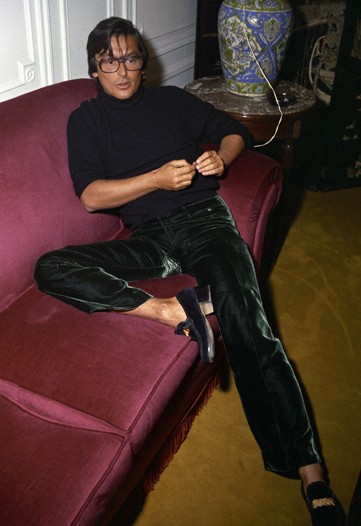
Robert Evans photographed at home in the ’70s for W Magazine

* My journal of inspiration, because a picture is worth…


The ’60s Eye

October 26, 2009 - 2 Responses

McCalls 1

You probably think this fabulous ’60s image is a page out of Vogue (“Makeup design by Giorgio di Sant’ Angelo” reads the credit!) but it’s from a magazine I found recently at my mother’s house, the November 1967 issue of McCall’s. The beauty story is “Feather Fantasies” and the issue also includes the debut of Truman Capote’s short story “The Thanksgiving Visitor” (his follow-up to  the classic “A Christmas Memory”) and an accompanying interview of Capote by Gloria Steinem, with his portrait by Avedon splashed across a page and a half of the once-standard oversize magazine (before postal regulations of the ’70s shrunk everything).

McCalls coverIn those days, McCall’s was the glamour girl of the “Seven Sisters” magazines – including Good Housekeeping, Redbook and Ladies’ Home Journal – aimed at the suburban wife, and enormously successful. (At their ’70s peak, the “Sisters” combined circulation was a staggering 45 million!) The McCall’s issue is an unbelievable time capsule, including the topical – a survey of doctors about the Pill (just six years old), then-First-Daughter Lynda Johnson’s tale of her engagement, a heartbreaking photo essay about a mining tragedy in Wales – amid the fashion and beauty stories and pages and pages and pages of holiday entertaining recipes, from cheese puffs and toasted anchovy rolls to candied grapefruit baskets (for gifts!) and three different and rather involved fruitcakes.

anouk

Whether intentional or not, the avian theme continues in a fashion photo of the actress Anouk Aimee, just after A Man and a Woman catapulted her to fame, in a Donald Brooks gown of guinea hen and ostrich feathers. She’s exulted as a “Real-Woman” – hyphenated – (“All else about this classically-boned, chestnut-maned enchantress is this-moment-real”) along with cover girl Marisa Mell, a now obscure ’60s bombshell (in the era of Ursula Andress and Virna Lisi), who was about to storm Broadway in a David Merrick musical version of, I swear, Mata Hari, directed by Vincente Minnelli (Liza’s dad, of course, and apparently the overproduced $800,000 vehicle flopped out-of-town in Washington and so there was no storming). Mell seems an odd cover choice for housewives in Denver and Detroit, from her “Real-Woman measurements, 38-24-38″ (shades of Mad Men’s Joan), but she reels (reals?) them in at the end: “Sex? Her ideas are both contemporary and ancient. ‘A Real-Woman doesn’t want sexual freedom; she wants to belong to a man. Men should stop the big hunt after business and money. Life is the important thing. Human beings are the miracles.’ Marvelous, miraculous Marisa.” Unfortunately my scanner is not big enough to relay the 14-inch high page of marvelous, miraculous Marisa in her floor-length fox and cheetah fur coat.

But wait, there’s more. After our proverbial homemaker has painted her eyelids like feathers, swallowed her Pill, relaxed with the new Capote fiction, zipped up her dinner gown and finished baking a batch of Fig Bonbons, she still has to have something to talk about – like the new music. McCall’s comes to the rescue with “How Not to Flop at Pop” with now cringe-worthy advice: “Don’t say. ‘it’s very pretty.’ Say things like, ‘It should go high on the charts,’ or ‘It turns me on.’ “

eye

One of the most amazing things is that nearly every photograph in the issue - from Marisa to the miners, from the eye shadow to the eggnog pie – was taken by the magazine’s art director, Otto Storch. Renowned in art direction history as part of the “New York School” of the ’50s and ’60s, he was a disciple of Harper’s Bazaar’s legendary Alexey Brodovitch, and helped hof_main_storchrevolutionize magazine design by integrating all the elements of a layout – headlines, text and photography – in his designs, often by twisting and manipulating type in this pre-computer era – as in his famed “forty-winks” layout. By 1967, Storch was nearing the end of his career at McCall’s – after two editors and with a 6-million circulation, TPTB veered more conservative as money men invariably do once something is a success – and he seamlessly moved into a full-time and lucrative career as an ad photographer for American Express, Volkswagen and others. Storch died in 1999, at age 86, and by then the magazine was on its last legs – if you don’t remember, it was sold in 2000 and Rosie O’Donnell became editorial director. Relaunched as Rosie, it tanked in 2002 amid lawsuits and widely reported infighting. The Golden Age of magazines, and McCall’s ‘’60s gloss and glamour were long gone by then.

MM-Mc Call's-Example.JPG